General Framework for Looking at Software Opportunities from First Principles

It’s important to really think through picking your spots, the market’s not completely wrong about AI concerns. Additionally we’re still in a higher rate environment pressuring valuations. Not all opportunities are equal. Being down 50% from ATH does not = cheap or attractive. Hopefully this general framework helps guide you scanning names from a high-level perspective
Enterprise AI Adoption: The Reality vs. the Narrative
The VC and startup world controls the media narrative around AI, but the reality for large enterprises is completely different. A startup can migrate from Claude to DeepSeek overnight to cut costs — but a company like Colgate CL 0.00%↑ is still just trying to understand Claude from a compliance perspective. Token price volatility is also a nightmare form a budgeting perspective. It is very unlikely they pivot to open-source in any reasonable timeframe; that kind of transition would take years. The loudness of the startup ecosystem masks how slowly the rest of the economy actually moves.
The “Who Builds It” Question
When thinking about how AI actually gets adopted at scale, there are really two paths:
The first is building in-house — hiring a team, paying salaries and benefits, and absorbing token costs that are increasingly hard to budget for. On top of that, you’ve got compliance constraints (fiasco for the compliance team and generally slow process for adoption), and the risk of eventually being priced out of the very platform you just built.
The second path is expecting your existing agency or software partner to integrate AI into their product suite, with the client paying slightly more for it.
For a company like Colgate thinking about ad spend optimization — do they build an internal team to cut out their agency, or do they just pay the agency a little more to have AI baked into their process?
The second option is far more realistic. The implication here is that deeply embedded software companies and agency partners who own a lot of client data and workflow may actually gain pricing power from AI, not lose it — which is the opposite of what the market currently seems to believe.
CRM (Salesforce) — Example of Where to be Skeptical & Things are Trickier
CRM is tricky. A few years ago, Elliott Management took a stake and pushed Salesforce to stop acquiring and focus on margin expansion. Management hit the targets — and the first thing Benioff did afterward was another acquisition. Nothing meaningfully changed on a GAAP basis. The co-CEO who was actually pushing for organic growth over roll-ups left for “new opportunities” shortly after. The company is essentially a roll-up, with the individual acquired pieces not really moving the needle.
The valuation concern compounds this. Right now, because of sentiment, institutional capital is likely stripping stock-based compensation out of the numbers themselves — going through the 10-Ks and 10-Qs line by line — rather than just using the non-GAAP figures companies report. That means what looks like a reasonable valuation when you look it up online may be significantly more expensive when modeled the way large institutions are actually doing it. Something that looks cheap on the surface can turn out to be really expensive once SBC is removed from the margin and cash flow profile.
On the competitive side, CRM’s edge has been bundling its acquisitions — Slack, Tableau, and others — into a package sale. But something like Tableau, which is essentially data visualization on internal data, is increasingly something companies can do in-house or with AI. If that bundle value erodes, the question becomes: why pay a premium for Salesforce when you can use a less expensive CRM and handle visualization yourself? Compare that to a company that is installed in the majority of hospitals and owns that vertical entirely — that’s a completely different moat.
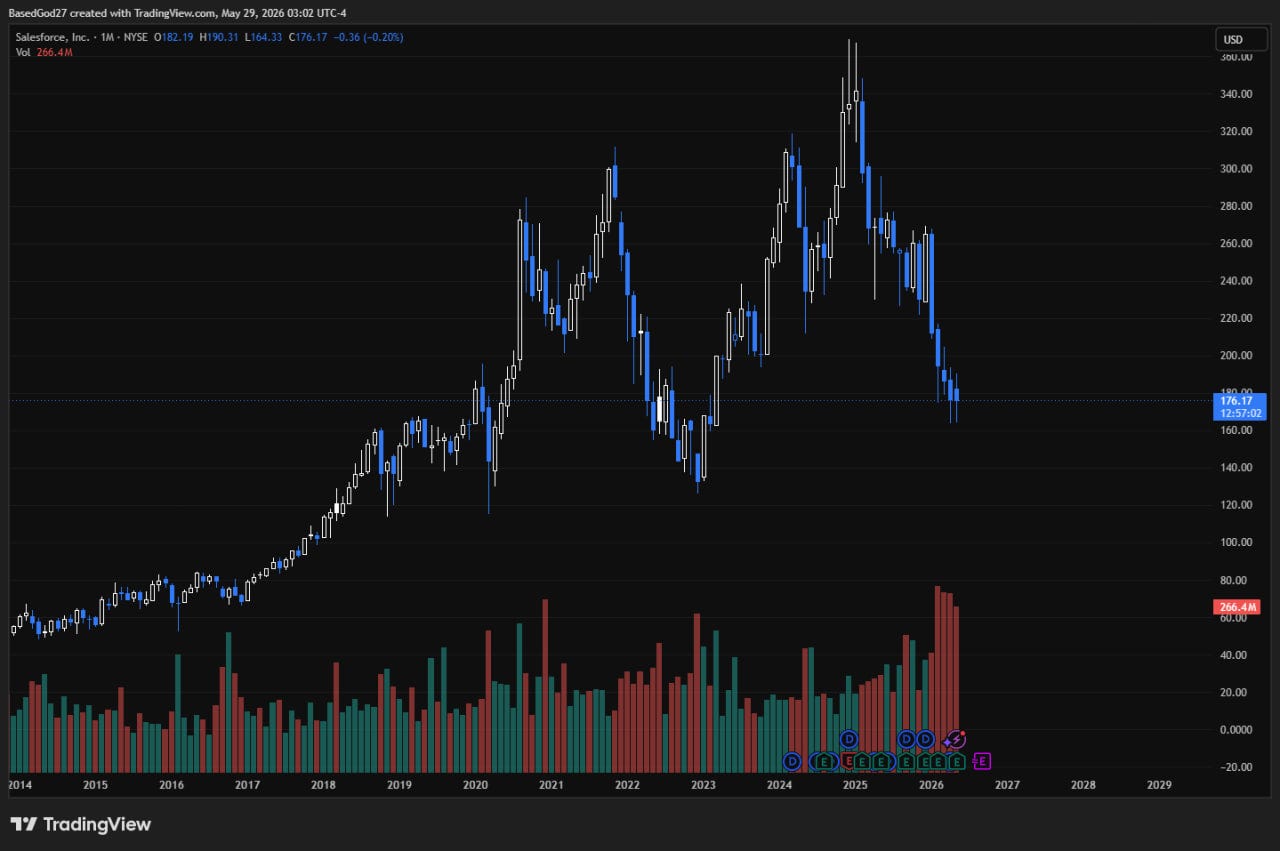
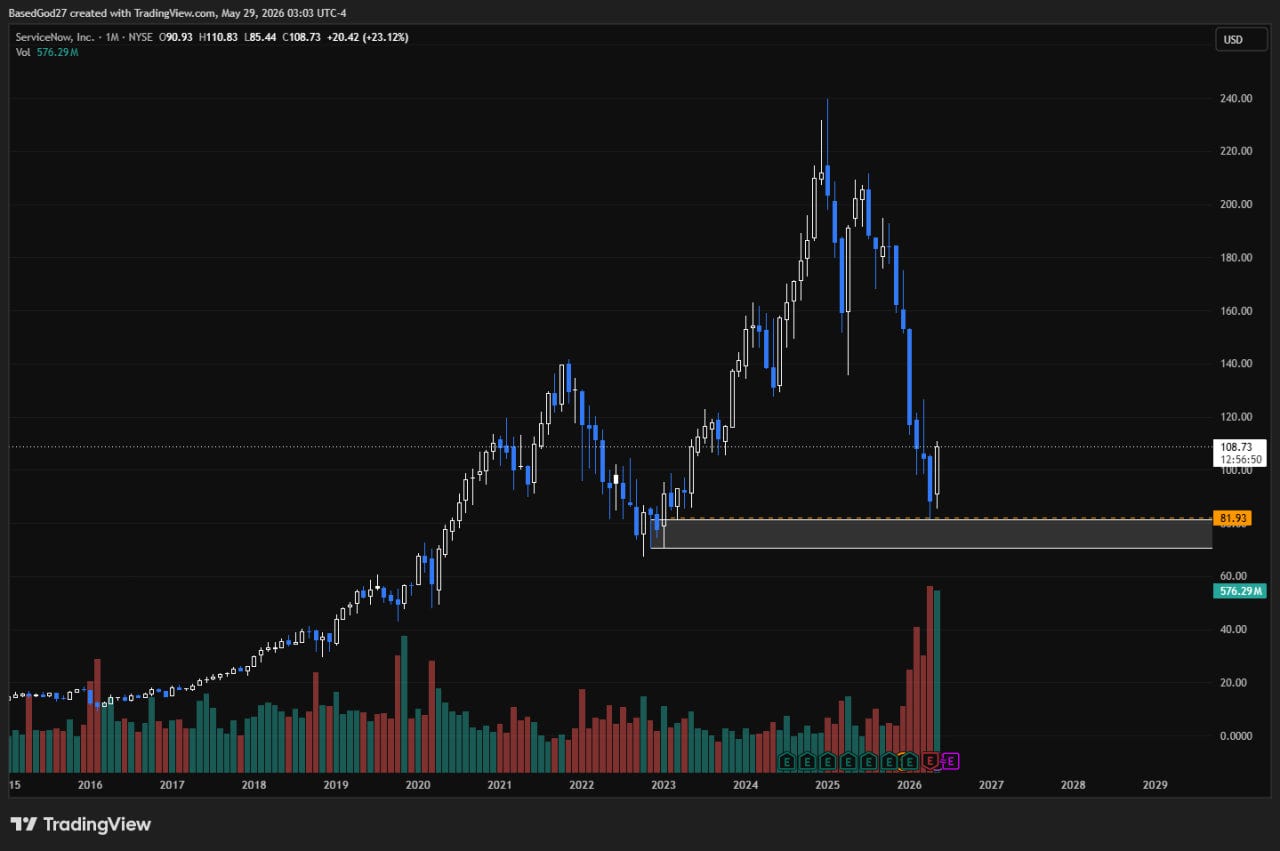
CRM might work as a rotation or sentiment-driven trade, and some still view it as a darling (ServiceNow is probably the bigger darling of the two right now). But if institutional money is using GAAP or near-GAAP numbers(maybe just removing SBC), the multiple looks a lot worse than the surface suggests — and that probably doesn’t change unless sentiment broadly turns and software gets back in vogue. This is something I view as important to understand since institutional $ flow is the biggest source of bid-demand.
$CRM vs. $NOW Monthly at yesterdays close before the catch up bid on software names accelerated at todays open - Very visible difference in bid-demand month-to-date:
The Durable Moat Framework
MSFT Excel analogy captures it well: even in a world where companies can theoretically do more in-house with AI, they’ll still pay $169 per year for Excel instead of building a spreadsheet tool themselves. In fact, until AI there's been no innovation to warrant a price hike. AI has completely changed that by enhancing the capabilities the user will have from provider plug-ins or MSFT copilot. Why not charge $300 per year ($25 per month)… that’s a little more expensive than a NFLX 0.00%↑ subscription. Why not $600/year ($50 per month)? They finally have leverage to increase the price MSFT 0.00%↑ for the first time in a long time.
The Excel analogy is making a point about stickiness and willingness to pay, even when a cheaper or DIY alternative theoretically exists.
You could, in theory, build a spreadsheet yourself — or use Google Sheets for free, or write some Python scripts to do the same thing. But basically nobody does, because Excel is already embedded in how everyone works, holds years of their data and formulas, and the switching cost plus the effort of rebuilding isn’t worth it. We know this because even when Google came out with sheets and pushed hard for enterprise adoption it failed, Excel & Office are just the king here.
The AI parallel: the concern about a lot of software companies is that AI will let companies “do it themselves” — build internal tools, cut out vendors, bring workflows in-house. And for some software, that’s probably true. But for software that is deeply embedded in a company’s operations, holds a lot of their data, and is woven into daily workflows, that threat is much weaker than it sounds. The friction of leaving is just too high, and the value of the existing integration is too real.
The Excel analogy applies to something like [Redacted Company] — a platform installed across the majority of hospitals, AI doesn’t really threaten that because they are holding years of patient data and is deeply integrated into clinical workflows. If anything, that company can charge more to add AI features on top of what’s already there, because the customer isn’t going anywhere. That’s the Excel dynamic: you’re not getting replaced, you’re potentially getting a new upsell opportunity.
The contrast is with something like a generic CRM platform or a data visualization tool — software where the core function is increasingly replicable, the data isn’t that sticky, and a company with the right team and AI tools could plausibly just... do it themselves. That’s the software that’s actually at risk.
Stickiness, embedded workflows, and vertical ownership are the most likely to survive the AI transition. The companies that are genuinely dangerous to own are the horizontal, general-purpose software providers with no captive data and no real switching costs — not the ones that own their vertical end-to-end.